

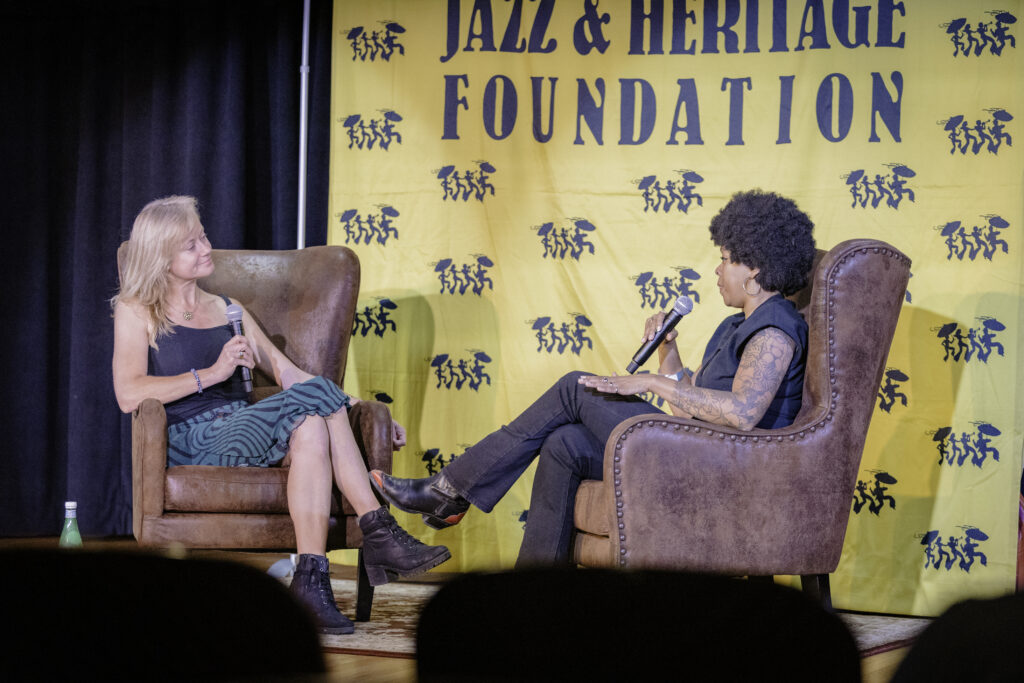
Oral History stage
The Festival celebrates the music. The Oral History Stage preserves the stories behind it.
The 2026 Crescent City Blues & BBQ Festival’s Oral History Stage aims to explore different threads of Southern music history: inheritance, preservation, New Orleans innovation, Memphis soul, Louisiana Creole culture, and the next generation of New Orleans artists.
In celebration of the 20th anniversary, the Oral History Stage will serve as a dedicated space to honor and document the people, places, and deep-rooted musical traditions behind the culture the festival celebrates. The first floor of Gallier Hall will transform into a cultural repository as festival artists engage in live conversation, diving into four connected chapters of Southern music history: Louisiana’s early rock & roll families, the preservation of the Bentonia blues tradition, the birth of New Orleans funk, and the evolution of Memphis soul.
From how they learned their craft to the venues that shaped them, to the mentors who passed down the music, and how their communities supported them, these conversations aim to capture the real, lived experiences of the artists themselves. The Oral History Stage offers a unique chance to acknowledge how things have changed, what traditions are at risk of disappearing, and what these legendary musicians hope the next generation will always carry onward.
Oral History Stage interviews will take place on the 1st floor of Gallier Hall.
Saturday, October 10: Linda Gail Lewis & Jimmy “Duck” Holmes
Interviewed by Scott Barretta
Steeped in geography, lineage, and the preservation of styles born outside major urban studio hubs, these interviews document how specific regional environments [the rural blues of Bentonia and the explosive crossroads of Ferriday] shaped artists who learned not through formal charts, but through absolute immersion.
2:00 pm – 2:30 pm: Linda Gail Lewis: Capturing the interior life of a musical dynasty, this interview looks past early rock & roll mythology to reveal the raw reality of a young woman claiming her creative agency and musicianship, all while navigating a legendary family legacy and a male-dominated industry.
3:30 pm – 4:00 pm: Jimmy Duck Holmes: Focusing on the survival of a localized, haunting tradition and the physical architecture that kept it alive, the Blue Front Cafe is examined as a business and a cultural sanctuary, exploring what it means to be the last chief guardian of the Bentonia sound in a rapidly changing world.
Sunday, October 11: George Porter Jr. & Booker T. Jones
Interviewed by WWOZ’s Soul Sister
Serving as the anchor of American funk and soul, George Porter Jr. and Booker T. Jones are founders of the modern groove, taking the traditional rhythm section and turning it into a complex, influential language that rewrote global popular music, rock, and hip-hop’s DNA.
- 2:00 pm – 2:30 pm: George Porter Jr.: This interview maps the organic evolution of New Orleans rhythm and blues pivoted to funk, the unspoken chemistry of the rhythm section, the masterclass of musical restraint, and how the shrinking of New Orleans’ historic neighborhood ecosystem impacts the way future generations learn to groove.
- 3:30 pm – 4:00 pm: Booker T. Jones: Bridging creative innovation with heavy social history, this interview explores the Stax studio as an accidental oasis of racial integration in a deeply segregated South, captures how a group of teenagers built a legendary house sound on pure collaboration, and unpacks what modern, technology-driven artists must protect regarding creative ownership and true musicianship.